
That line, attributed to Sam K. Jerome, Head of Corporate Affairs at COCOBOD, struck like a match in dry season, injecting institutional weight into what had until then been largely partisan exchanges. It did not emerge in isolation.
The minority's tour through Ashanti, led by Nsawam Adoagyiri MP Frank Annoh Dompreh, has amplified rural frustration and sharpened the political temperature in cocoa-growing districts. Moving through cocoa communities, the caucus framed the farmgate adjustment as proof that farmers were being short-changed. Jerome’s reference to Chairman Wontumi alluded to the controversy over cocoa road contracts and alleged irregularities during the previous administration. The programme, meant to open up farming communities, became clouded by claims of inflated contracts and opaque procurement.
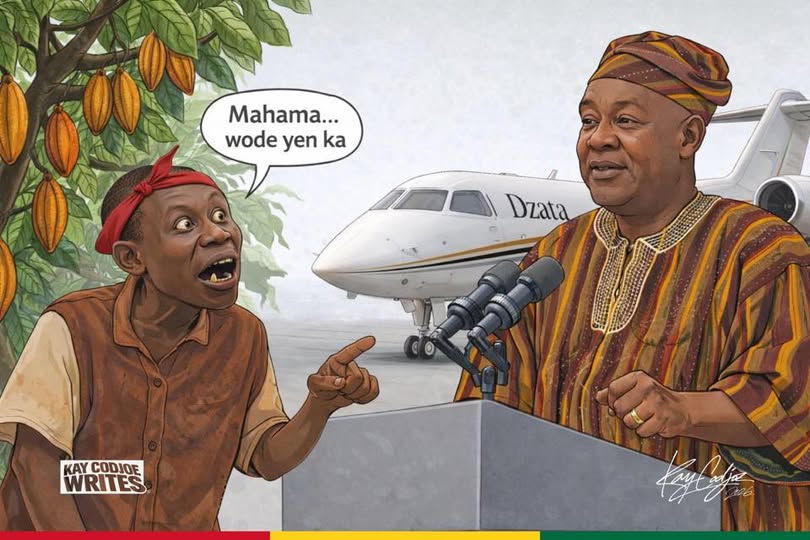
By invoking Wontumi, the remark suggested that today’s outrage cannot be divorced from yesterday’s fiscal decisions. The debate over cocoa pricing is, therefore, not only about world markets and exchange rates but also about legacy liabilities and accumulated financial strain at COCOBOD. And in the villages, that institutional strain has a face — far removed from private-jet optics and measured instead against the unmet expectations of a RESET pledge that promised relief, renewal, and restoration. One farmer, bandana tied tightly across his forehead, roared, “Mahama… wo de yen ka.” It was not spectacle. It was strain. But strain must still pass through arithmetic.
As of 16 March 2026, global cocoa futures were trading between US$3,254 and US$3,392 per tonne, averaging roughly US$3,300 per tonne. That translates to about US$211 per 64kg bag. At the Bank of Ghana interbank mid-rate of approximately GH¢10.87 to the dollar, 70 per cent of that world price equals about US$148 per bag, or roughly GH¢1,609 per 64kg bag. Ghana’s official farmgate price for the remainder of the 2025/2026 season stands at GH¢2,587 per 64kg bag, equivalent to GH¢41,392 per tonne. By direct comparison, the domestic price is approximately GH¢978 above the calculated 70 per cent benchmark per bag. In effect, farmers are currently receiving close to 90 per cent of the achieved gross FOB price, rather than the traditional 70 per cent reference that dominates political rhetoric.
These are not partisan claims. They are conversions. Yet a numerical margin does not dissolve anxiety. Farmers in Offinso and Bosome Freho are not protesting exchange rate formulas. They are protesting pressure. Reports of sack shortages and slow LBC purchases persist, even if their scale remains disputed. A farmer who cannot sell his beans, or who waits too long to be paid, feels distress regardless of how impressive the benchmark looks.
This is where leadership is tested. If the arithmetic supports the pricing decision relative to global markets, governments must communicate that clearly and consistently. If hedging positions, forward sales, or cash flow constraints shaped the timing of the adjustment, say so plainly. If operational bottlenecks exist, resolve them with urgency.
But one principle must remain nonnegotiable: farmers must be paid what is due them, fully and promptly. A price above benchmark loses moral force if liquidity fails at the village level. Cocoa is not a line item on a spreadsheet. It is school fees, hospital bills, and next season’s fertiliser. Politics may thrive on volume. Agriculture survives on trust. The numbers matter. The hardship matters too. In a nation whose economic spine is cocoa, leadership cannot afford to ignore either.






No comments yet. Be the first to comment!