
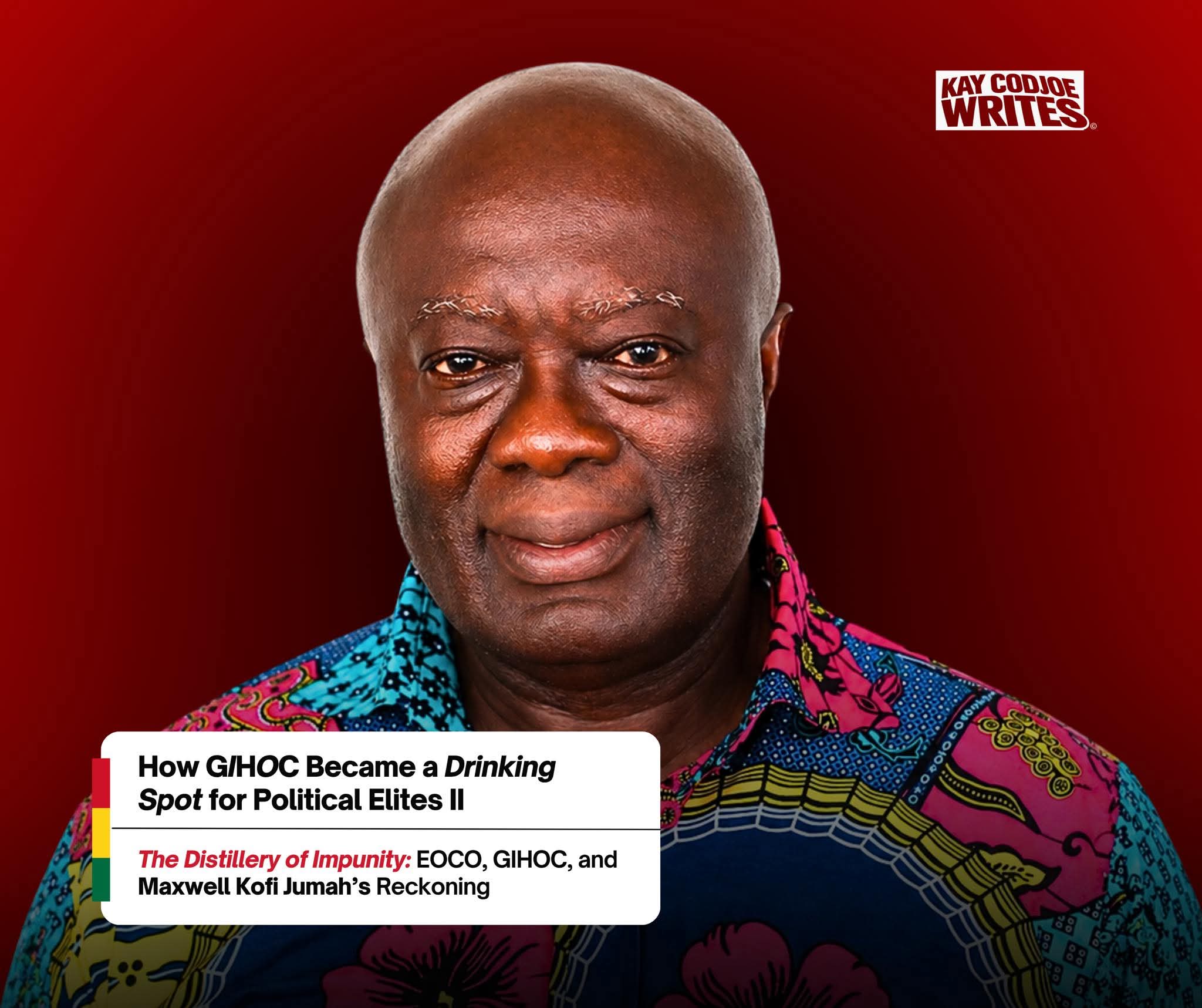
Barely a year ago, warnings about Maxwell Kofi Jumah were dismissed as political noise. Some defended him reflexively. Others framed him as a victim of political targeting, as though the state had randomly chosen to harass a former GIHOC boss for sport. But today, the same Maxwell Kofi Jumah is back in EOCO custody under investigations tied to financial and administrative irregularities during his tenure at GIHOC Distilleries.
Same allegations. Same stench. Bigger embarrassment. Yet this time, the shadow hanging over the matter stretches beyond luxury vehicles and questionable allowances. It stretches all the way to Aboso. Because the Aboso Glass Factory is not just another abandoned state facility. It is one of the surviving symbols of Ghana’s industrial dream under Kwame Nkrumah. A factory built not merely to produce glass but to produce jobs, dignity, and industrial confidence.
For years, Aboso stood like a wounded monument to Ghana’s unfinished economic ambitions. Then came promises of revival. In 2019, under Maxwell Kofi Jumah’s leadership at GIHOC, Ghanaians were told the factory would return to life through industrial restoration and strategic recovery. But according to growing reports and local complaints, many residents in Aboso began witnessing something disturbingly different.
It was no longer looking like revival or reconstruction. It was beginning to look like removal and dismantling. Roofing sheets allegedly disappearing. Scrap allegedly being hauled away. Concerns over factory assets being stripped rather than restored. A national industrial symbol slowly turning into what many locals feared was a harvesting ground masquerading as rehabilitation. And suddenly, the Jumah affair stopped looking like ordinary administrative misconduct. It started resembling something more dangerous: the conversion of national decline into private opportunity.
The allegations are astonishing even by Ghanaian standards. A Genesis G90 luxury sedan was reportedly purchased for approximately GH¢4,943 despite being valued at nearly GH¢99,000. unauthorised sales of GIHOC properties reportedly worth over $700,000. Allegations of weekly allowances of GH¢40,000 paid to him while ordinary workers struggled. Questions surrounding inflated staff numbers inside a struggling state enterprise. And now, investigations are reportedly touching issues connected to the Aboso factory. At this point, GIHOC was beginning to look less like a state enterprise and more like a clearance auction with letterheads.
State-owned enterprises in Ghana have quietly become playgrounds for politically connected managers who speak the language of patriotism upon arrival, only for official vehicles to disappear, payrolls to expand mysteriously, and public assets to begin changing hands with alarming speed a few years later.
Then comes the most insulting part. When investigations begin, they suddenly rediscover democracy. They rediscover human rights. They rediscover constitutionalism. They rediscover political persecution. But where was this constitutional morality when struggling public institutions were allegedly being converted into private convenience?
Where was this democratic conscience when a factory meant to symbolise industrial rebirth allegedly became associated with dismantling and extraction? This is why many citizens are angry. Not simply because of one man. But because Maxwell Kofi Jumah represents a broader political culture that has normalised elite entitlement while ordinary citizens endure economic suffocation.
The trader is squeezed by taxes, the teacher survives on deductions, the nurse works through exhaustion without equipment, and the graduate rots in unemployment. Meanwhile, politically connected officials allegedly acquire luxury state vehicles at prices that cannot buy a decent kiosk container in parts of Accra. And then the public is told investigations are politically motivated. No.
The real political persecution in Ghana is what corruption does to ordinary people every single day. It is the collapsing hospitals, abandoned roads, dead factories, unemployed youth, and the slow destruction of public trust.
What is equally disturbing is what this reveals about Ghana’s oversight systems. Where was SIGA? Where were the boards, auditors, and supervising ministries? How does a state enterprise descend into such controversy without regulators either failing completely or deliberately looking away? One man alone cannot execute institutional decay at this scale without silence assisting him. That silence is part of the scandal too.
This case must not end with dramatic arrests and newspaper headlines. Ghana has seen enough theatrical accountability. The real test is whether institutions will pursue these investigations fully, professionally, fearlessly, and transparently regardless of party colours or political connections.
Because if this case quietly dies after the outrage fades, then the lesson to future appointees will be simple: loot carefully, build political protection, survive the media cycle, and wait for the country to forget. That cannot become the operating philosophy of the republic.
Maxwell Kofi Jumah’s story is no longer just about one former GIHOC boss. It has become a national mirror reflecting the dangerous intimacy between political power and public resource abuse in Ghana. And perhaps the saddest part of all this is Aboso itself.
A factory once imagined as a symbol of industrial hope now stands at the centre of allegations tied to extraction, decay, and investigations. That alone should trouble every serious Ghanaian.


Ziem Kuufaar
Apr 30, 2026 6:29 amThanks for letting me know some details of the case. Keep updating us
Sunkari Garven
Apr 30, 2026 8:02 amPolitical appointments now looks more lucrative than goldmine. This man must serve at least 10 years in prison.