
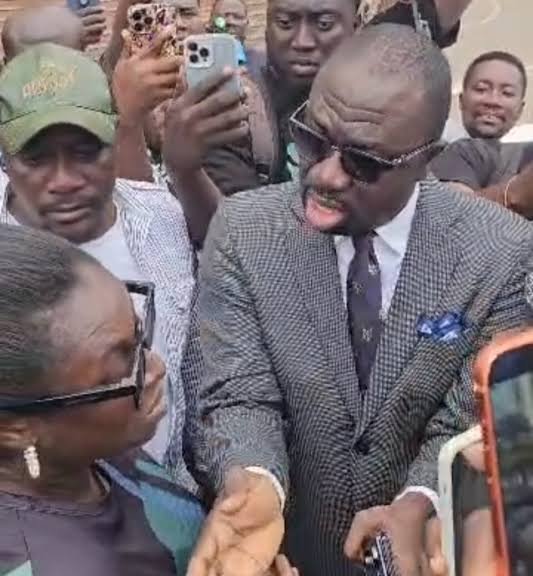
The attempted arrest of the Member of Parliament for Manhyia South, Nana Agyei Baffour Awuah, by officials of the Economic and Organised Crime Office (EOCO) on Wednesday, September 23, 2026, has reopened an old and uncomfortable question in Ghana's Fourth Republic: where does legitimate law enforcement end and the perception of political persecution begin?
This is not because Members of Parliament are, or ought to be, above the law. They are not. The more important question is whether an MP can ever be investigated or arrested. The Constitution does not create such an absolute sanctuary. The question is how, when and under what lawful authority such powers are exercised, particularly where the suspect is a sitting legislator, and the circumstances are politically charged. And that is precisely where the Manhyia South episode becomes important.
According to EOCO, its officers attempted to arrest Nana Baffour Awuah in connection with an ongoing investigation after he allegedly failed to honour two invitations issued to him in February 2026. EOCO later said it abandoned the operation because the situation had escalated and further action could have endangered public safety. The Office has maintained that parliamentary membership does not terminate an investigation or place an MP beyond the reach of the law.
The MP, however, has given a markedly different account. He says the woman who approached him could not adequately establish her identity or produce an arrest warrant or other proof of authority, and that he became suspicious when he was asked to accompany her to EOCO.
Therein lies the problem: Two narratives, one incident, and a public that has seen this movie before. The Manhyia South episode is not the first controversy involving the arrest or attempted arrest of a sitting legislator in the Fourth Republic.
In July 2011, then Abuakwa South MP Samuel Atta Akyea was arrested by the police at the Accra High Court and charged with stealing and fraudulent breach of trust arising from a private commercial dispute. Barely seven months later, in February 2012, another sitting MP, Osei Bonsu Amoah, then MP for Aburi-Nsawam, was arrested by armed police in connection with investigations into the controversial Woyome judgment-debt affair.
Then came the arrest of Assin North MP Kennedy Ohene Agyapong in April 2012. He was arrested by the Criminal Investigation Department over comments made on Oman FM and subsequently stood trial on charges relating to conduct conducive to a breach of the peace and causing fear and alarm. More recently, in May 2024, Asutifi South MP Collins Dauda was arrested by the police over alleged disturbances during the limited voter-registration exercise at Kukuom.
These cases are important not because they prove that law-enforcement agencies have always acted unlawfully. They do not. Rather, they demonstrate that the collision between parliamentary privilege, criminal investigation, and political tension is not a new phenomenon in Ghana.
The parliamentary immunity in this circumstance is where public discussion often becomes confused. Article 117 of the 1992 Constitution states that civil or criminal process from outside Parliament shall not be served on or executed against the Speaker, a Member or the Clerk while that person is on the way to, attending, or returning from proceedings of Parliament. That is protection from interference with parliamentary functions. It is not a declaration that MPs are immune from criminal investigation.
In fact, Speaker Alban Bagbin clarified the position in Parliament in May 2026, stating that security agencies do not require his permission before arresting an MP suspected of wrongdoing. What is required, he explained, is notification so that the circumstances can be assessed against any applicable parliamentary privilege or immunity. This distinction matters enormously.
If an MP commits an ordinary criminal offence, parliamentary membership cannot transform the alleged offence into an untouchable act. Conversely, an investigative agency cannot simply invoke the phrase “we are investigating a crime” and assume that every manner of arrest is automatically lawful.
The Constitution itself protects every person's liberty. Article 14 permits deprivation of liberty in specified circumstances, including reasonable suspicion of having committed or being about to commit a criminal offence, but also requires that an arrested person be informed immediately of the reasons for the arrest and of the right to a lawyer.
So the real democratic question is not “Should an MP be arrested?” It is: Was the arrest legally authorised? Was the proper procedure followed? Was the MP informed of the reason? Was the officer properly identified? Was the timing and location appropriate? Were parliamentary privileges respected? And can the investigative agency demonstrate that the same procedure would have been used against an ordinary citizen? Those are legitimate questions.
There is another disturbing dimension to the present controversy. The incident occurred at the Accra High Court after Nana Baffour Awuah had represented a client. Video footage circulating publicly showed an EOCO official approaching him and a subsequent confrontation around his vehicle. Minority Leader Alexander Afenyo-Markin has consequently called on the Chief Justice to examine whether investigative agencies should enter court premises with the specific intention of arresting suspects.
That question deserves institutional consideration independent of partisan politics. Courts must remain places where citizens, lawyers, accused persons, witnesses and officers of the law can attend proceedings without fear that the very institution administering justice will become the scene of an unexpected confrontation. If there is a lawful reason to arrest someone who has appeared in court, the law must determine the appropriate procedure. The solution cannot be to normalise dramatic confrontations at court premises simply because an investigative agency believes it has the power to arrest.
There is this shadow of “orders from above” where lies the broader question of institutional independence entering the discussion. In October 2018, then ACP Dr Benjamin Kwasi Agordzor, speaking at an Institute for Democratic Governance (IDEG) round table, publicly called for the depoliticisation of the Police Council. The Ghana Police Service itself was reported to have expressed concern that presidential appointees dominated the Council. That intervention should not be dismissed merely because it came from a police officer.
It raises a fundamental institutional question: can an investigative institution command public confidence if citizens believe that its operational independence is subordinate to political authority? The question is not whether every police officer or EOCO investigator is politically compromised. There is no evidence to make such a sweeping conclusion.
The question is whether our institutional architecture is sufficiently designed to prevent that perception from arising in the first place. A democracy should not depend upon citizens believing that every investigator is incorruptible. It should establish systems in which even an investigator who wants to abuse power finds it difficult to do so.
Another thing is when the police say “we were acting on orders.” There is perhaps no phrase more corrosive to institutional confidence than the familiar explanation that an officer was merely “acting on orders from above.” Every institution requires command, but democratic policing requires something more than command.
It requires lawful command; otherwise, responsibility disappears into the bureaucratic ceiling. The junior officer says, “I was following orders.” The senior officer says, “I was acting within my mandate.” The political authority says, “I never instructed anybody.” And the citizen is left staring at the wreckage, wondering who, exactly, is accountable.
There is another reason why incidents of this nature immediately acquire political colour in Ghana. Our two major political traditions have, at different times, found themselves on both sides of the investigative stick. When an opposition politician is investigated or arrested under a government controlled by the other party, supporters frequently see persecution.
When the same political actors become part of government, and their opponents are investigated, the language often changes: suddenly it becomes accountability, anti-corruption and equal application of the law. This is an unhealthy cycle.
The answer is not to stop investigating politicians. The answer is to create institutions whose procedures are so transparent, consistent and professionally defensible that the political identity of the suspect becomes irrelevant to the credibility of the process.
If an NPP or NDC MP is suspected of a crime, investigate him. If a government minister or a former minister is suspected of a crime, investigate him. If an ordinary citizen is suspected of a crime, investigate him. But in every case, the same law, the same standards and the same procedural safeguards must apply.
The “honourable” Title should not become a shield. There is also a legitimate public frustration with the frequency with which elected representatives find themselves embroiled in allegations of criminal wrongdoing. But caution is necessary here because an allegation is not a conviction, an invitation is not an indictment, an arrest is not proof of guilt, and an MP being investigated does not mean Parliament itself is corrupt.
Yet elected representatives do occupy a special place in a constitutional democracy. They exercise legislative power on behalf of the people. The title “Honourable” attached to their office is therefore more than ceremonial decoration; it represents an expectation of public conduct. That expectation should make MPs more accountable, not less. Nor should parliamentary privilege be interpreted as a hiding place for wrongdoing.
Parliamentary privilege exists to protect the independence and effectiveness of Parliament, not to create personal immunity for criminal conduct. Indeed, EOCO itself has now made this point precisely, saying that parliamentary membership does not terminate an investigation while simultaneously acknowledging that it must respect constitutional privileges and protections.
What Ghana should fix now is this. The Manhyia South episode should therefore not become another political shouting match in which one side screams “witch-hunt” and the other shouts “corruption.” It should become a constitutional and institutional learning opportunity. The country should establish clearer operational protocols for the arrest or invitation of sitting MPs.
Investigative bodies should have clearly documented procedures for notifying Parliament where parliamentary privilege may arise. Officers conducting politically sensitive arrests should be properly identifiable and should clearly communicate the legal basis for the action. There should be transparent internal authorisation for high-profile arrests. And where an operation becomes controversial, an independent review mechanism should be capable of determining whether the officers acted within their lawful mandate.
The objective should not be to make MPs untouchable. It should be the opposite: Make MPs accountable under law while making investigators accountable under law too.
The Constitution must protect the citizen from both sides. There is a temptation to portray parliamentary immunity as the great villain in this story. That would be too simplistic. The Constitution's parliamentary privileges exist because Parliament itself must be protected from intimidation by the Executive and other centres of power. Article 117 is part of that architecture. But constitutional protection can become problematic when misunderstood or abused.
The answer, however, is not necessarily to abolish parliamentary privilege altogether. The better question is whether the existing protections are sufficiently clear, properly understood, and properly enforced. After all, removing constitutional protections because some people may abuse them could leave future parliaments dangerously exposed to exactly the kind of executive interference the protections were designed to prevent.
This is why the constitutional review conversation should be about more than personalities. It should examine the relationship between Parliament, the Executive, the Police Service, EOCO, and other investigative institutions. It should ask who appoints whom. Who supervises whom? Who can give instructions to whom? Who investigates abuses by whom? And, most importantly, who ultimately answers to the citizen?
Today’s scene, we must let the law arrest the MP — not politics. Nana Baffour Awuah may ultimately be innocent or guilty of whatever offence is under investigation. At this stage, neither EOCO's allegation nor the MP's account should be converted into a judicial conclusion. What matters is that the investigation proceeds according to law.
If EOCO has a legitimate case, let it make the case. If the MP has breached the law, let the evidence establish it. If EOCO violated the law, let that too be established. If the MP misunderstood or resisted a lawful process, the law should determine the consequences. But Ghana cannot continue building a democracy in which every arrest of a politically exposed person automatically becomes a battle between political parties. That is how institutions become partisan in the public imagination even when individual officers may be acting professionally.
The Republic needs something more durable than political loyalty. It needs institutions whose actions can survive scrutiny regardless of which party occupies the seat of the presidency. Because today the investigator may be pursuing your political opponent. Tomorrow, the same investigator may be pursuing you. And when that day comes, the only shield worth having should not be who is in power. It should be the Constitution, the law, and due process. That is the Ghana we ought to be building.



No comments yet. Be the first to comment!