
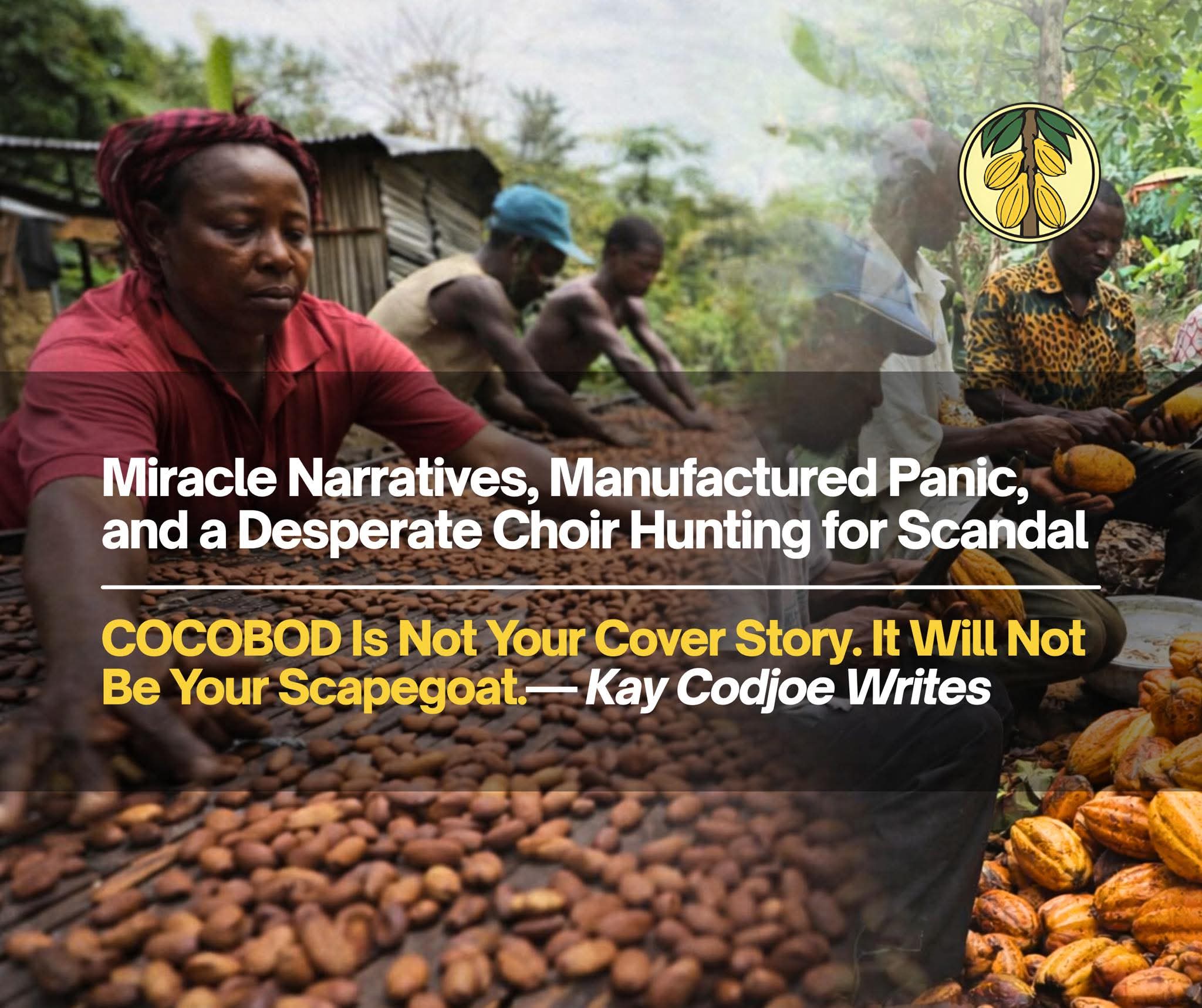
Something calculated is unfolding again. The moment Ghana confronts structural failures inherited from the past, a familiar playbook surfaces. Manufacture urgency. Plant suspicion. Weaponize speculation. Then pin a decades-deep institutional crisis on whoever currently occupies the chair.
This time the target is COCOBOD. More precisely, Randy Abbey. The script is simple. Rewrite history fast enough and hope the public forgets who built the cracks in the foundation. But the cocoa sector is not naïve. Farmers know. Licensed buying companies know. Transporters know. Rural communities know. They have lived through every season of this slow erosion.
This crisis did not start in 2025. It did not start with Randy Abbey. COCOBOD leadership has rotated across governments, each era leaving distinct footprints. Following the exit of John Henry Newman around 2001, the board went through a transitional leadership phase before Isaac Osei’s appointment in 2006 under President Kufuor. Osei presided over strong production growth and cocoa road expansion, even as financing commitments began accumulating and later strained the board’s balance sheet. Anthony Fofie led from 2008 to 2013 across the close of the Mills administration and the beginning of the Mahama presidency, emphasizing price stabilization and farmer support while borrowing pressures steadily increased.
Dr. Stephen Kwabena Opuni served from 2013 to 2017 under President Mahama, driving aggressive fertilizer and productivity interventions even as procurement controversies and rising operational costs became entrenched public concerns. Joseph Boahen Aidoo then served from 2017 to early 2025 under President Akufo-Addo, navigating escalating production volatility linked to illegal mining expansion, disease outbreaks, climate stress, and mounting debt exposure tied to forward sales financing and cocoa road commitments, raising persistent sustainability warnings.
By the time Randy Abbey assumed office in 2025 under President Mahama’s second term, debt exposure, infrastructure liabilities, market volatility, and declining production had already converged into a fragile institutional position. These pressures span governments. They span parties. They span years. Debt piled up. Forward sales tightened. Production slipped under the weight of galamsey and climate shocks. Operational costs ballooned. Audit concerns surfaced. Borrowing increased simply to sustain liquidity. None of this is partisan fiction. It is documented history.
To suggest this complexity suddenly materialized because of one CEO is not serious analysis. It is narrative engineering. And the timing is revealing. Macroeconomic indicators are stabilizing. The cedi is regaining footing. Investor sentiment is cautiously improving. National anti-corruption conversations are intensifying. Suddenly, panic is manufactured around COCOBOD.
And woven into the hysteria is the recycled fear word "haircut," deployed as if repetition alone could trigger old trauma. Ghanaians remember the real haircut of the Ofori Atta debt restructuring era. They remember who presided over that chapter. Today’s miracle narrative is echoed by a desperate choir hoping anxiety will achieve what evidence cannot.
Randy Abbey did not create legacy debt. He did not design the forward sales architecture. He did not initiate controversial procurement regimes. He did not unleash global cocoa price volatility. He inherited a sector already under structural stress. That does not place him above scrutiny. If there is misconduct, prove it. If there are conflicts of interest, investigate them. If there are irregularities, publish them. Accountability must be evidence-driven, not headline-driven.
But turning COCOBOD into a political battleground before reform outcomes are visible suggests something deeper. Fear. Fear that genuine structural accountability might begin tracing responsibility backward. Miracle narratives distort perception. Distorted perception erases history. Ghanaians must reject illusion and demand proof. COCOBOD is too strategic for theatrical blame games. It funds education. It stabilizes foreign exchange. It sustains rural livelihoods. It anchors national agriculture. Turning it into political theater reveals opposition desperation, not governance concern.
The sector needs discipline, transparency, reform velocity, and mandate clarity. It does not need panic choreography. If allegations exist, bring documents. If audits exist, publish them. If procurement concerns exist, file them formally, as the Hon. Assafuah petition to CHRAJ and OSP has done. Ghana has institutions. Let evidence, not noise, determine what is true.
Speculation is not oversight. Noise is not reform. The NPP’s miracle choristers trying to offload historical responsibility onto current leadership may soon realize the public is no longer easily distracted. Citizens now read balance sheets, track commodity cycles, and remember the policy decisions that shaped this moment. This time the audience is not passive.
This time the record matters. And this time, Ghana is watching closely.





No comments yet. Be the first to comment!