
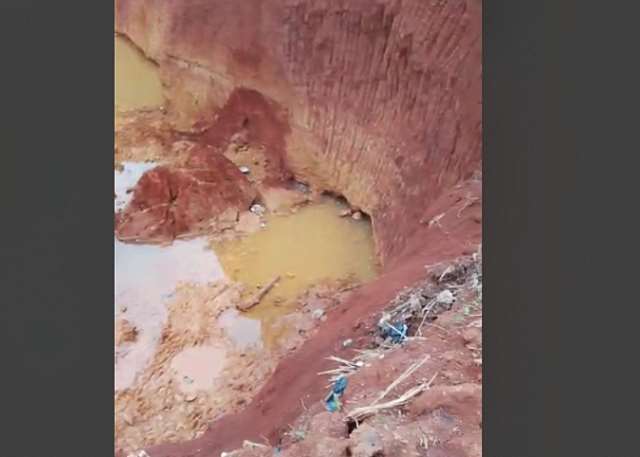
Death is never a light matter. Even the loss of an animal can stir grief in the heart of an ordinary person. Human instinct naturally leans toward compassion whenever life ends. Yet there are moments when that instinct hesitates — moments when the mind conflicts with the heart — particularly when tragedy stems directly from wrongdoing. Such is the emotional tension many Ghanaians feel whenever news breaks that illegal miners have been trapped in collapsed pits. The reaction is often not one of pure sorrow, nor of celebration, but a difficult mix of sadness, relief, and acceptance. It becomes humanly painful to mourn those whose own actions have pushed the nation toward environmental ruin.
Galamsey has grown into one of the most ravenous forces devouring Ghana’s future. Once fertile farmlands now resemble bomb-cratered wastelands. Rivers that once sparkled with life — Pra, Ankobra, Birim, Offin — today flow like muddy poison, thickened with mercury and cyanide. Communities that depended on these water bodies for generations now queue for treated water, while aquatic life quietly disappears under layers of chemical waste. There are children in modern Ghana who have never seen a clean river. That reality alone is a national tragedy.
Illegal miners often defend their operations with a familiar argument — there are no jobs. Unemployment indeed pushes many young people into dangerous survival choices, but the lack of employment cannot justify the destruction of life-sustaining resources. If joblessness becomes an excuse to poison rivers, destroy cocoa farms, and endanger entire communities, then where do we draw the line? Should every unemployed person begin to destroy land, pollute water bodies, and cause others to die slowly from toxic contamination? Poverty explains their desperation, but it cannot erase the consequences of their actions. Thousands of Ghanaians are jobless, yet they do not take up activities that threaten the survival of millions. To claim unemployment as a defence for galamsey is, therefore, an argument that collapses under the weight of logic and morality.
How then do we fully empathise with the very people responsible for this devastation? Illegal mining does not happen in isolation. Every pit dug is a wound in the earth. Every gallon of mercury poured into a river is a silent death sentence for farmers, fishermen, unborn children and generations yet to come. Galamsey is not simply an economic activity — it is the slow poisoning of a nation. So when the earth collapses on those who have been digging its belly without remorse, many Ghanaians find themselves neither jubilant nor heartbroken. Instead, they whisper the age-old law of consequences: a man harvests what he sows.
Comparisons to armed robbery are not far-fetched. When an armed robber is shot in the act, the public rarely weeps openly. The life lost is still a life, yes — but society instinctively understands accountability. In the case of galamsey, the “robbery” is even more extensive and far-reaching. It is the theft of water, of fertile land, of food security, of environmental inheritance.
Worse still, behind the people in the rivers and pits are the well-dressed architects of destruction. Some politicians speak passionately against galamsey by day, yet quietly sponsor heavy equipment by night. Others influence security operations, obstruct investigations, and trade environmental preservation for wealth and power. Their hypocrisy fuels a crisis that threatens to outlive all of us. Equally disturbing is the complicity of some traditional rulers who, instead of protecting ancestral land, have become auctioneers of it. Lands handed down through lineage — sacred and life-giving — are being exchanged for short-lived wealth, leaving behind poisoned soil and ghosted rivers.
It is for these reasons that the death of a galamsey operator evokes conflicted emotions rather than national grief. We feel human sorrow at the loss of life, yet we cannot ignore the slow killings their activities bring upon innocent communities. The illegal miner may die instantly in a pit, but the environmental damage they leave behind kills slowly for decades. We mourn the human being — but we cannot cry away the consequences.
Ghana stands at a crossroads. If we are to salvage what is left of our rivers, forests and agricultural soils, the fight must be firm and sincere. The law must be enforced without fear or favour, financiers must be exposed, and chiefs who sell communal land must face consequences without ceremonial courtesy. The nation must elevate environmental protection above personal gain.
Until then, the death of a galamsey operator will continue to sit in the nation’s conscience like a heavy stone — painful, yet disturbingly fair. Sympathy is a gift we owe to those who preserve life, not those who deliberately destroy it. If we hope to leave behind a Ghana worth inheriting, we must defend the land with the urgency it deserves, for our lives depend on it more than gold ever will.
The Trial News


No comments yet. Be the first to comment!